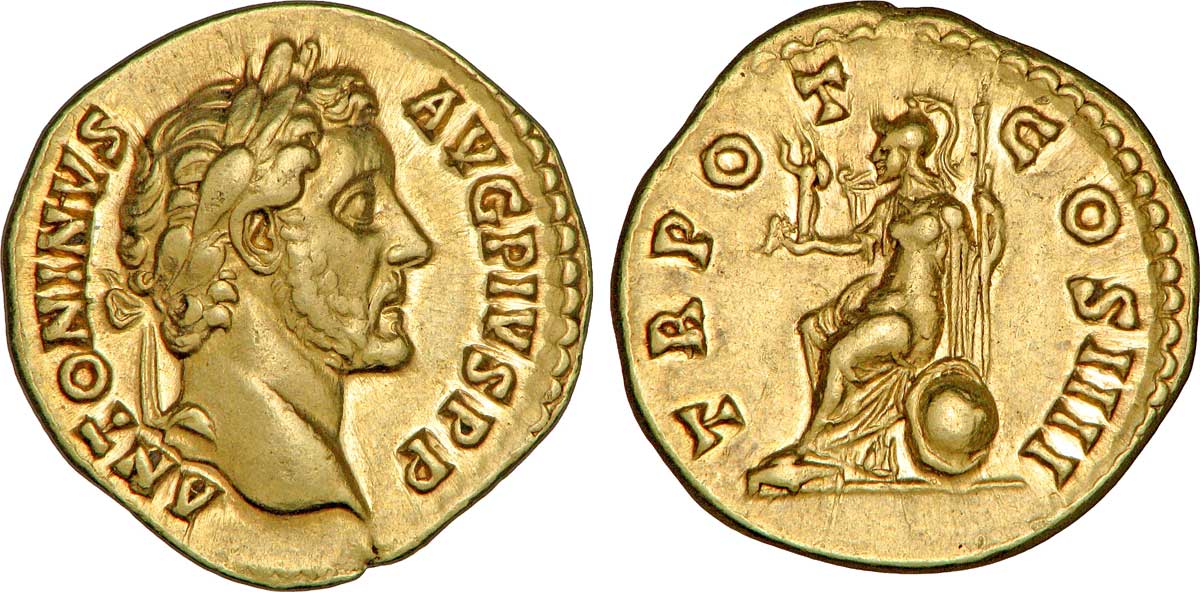
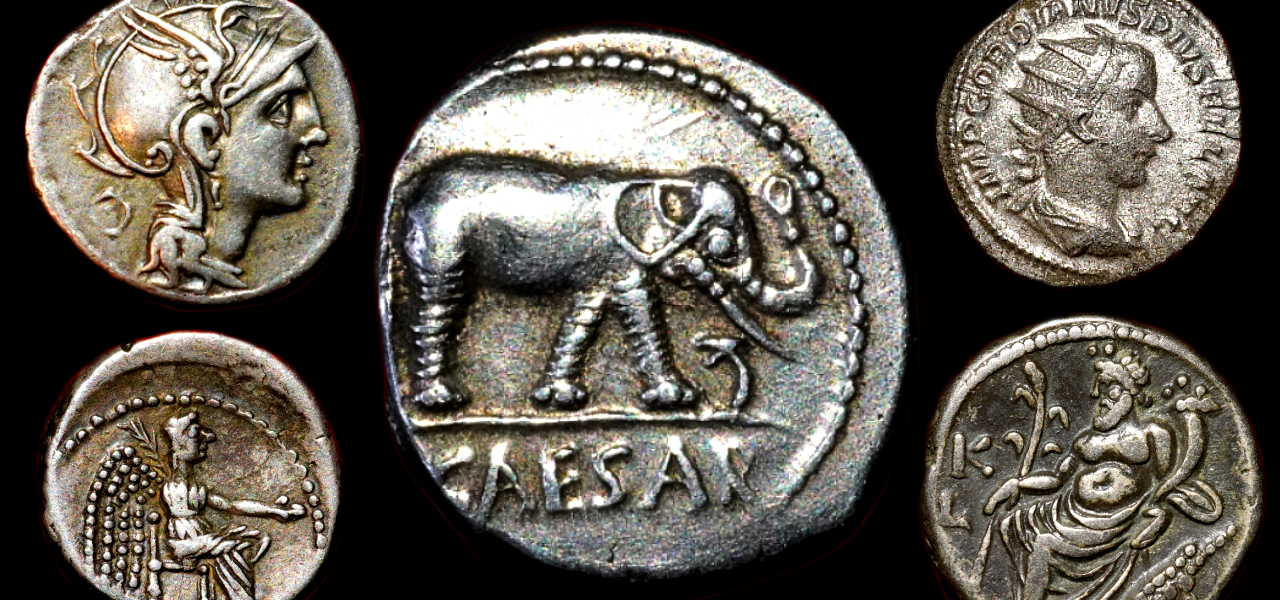
When people think about Roman coins, two metals usually come to mind: gold and silver.
Gold fascinates collectors because of its rarity and value. Yet it was silver that truly powered the Roman Empire for centuries. Silver paid the soldiers, facilitated trade and helped structure the Roman economy.
At the same time, it was also the metal that would eventually reveal the weaknesses of the Empire and accompany its decline.
In this article, we will explore the main Roman silver coins, understand the appearance of billon coinage and discover how the Roman monetary system gradually deteriorated before undergoing major reforms.
The Denarius: The Coin That Built Rome
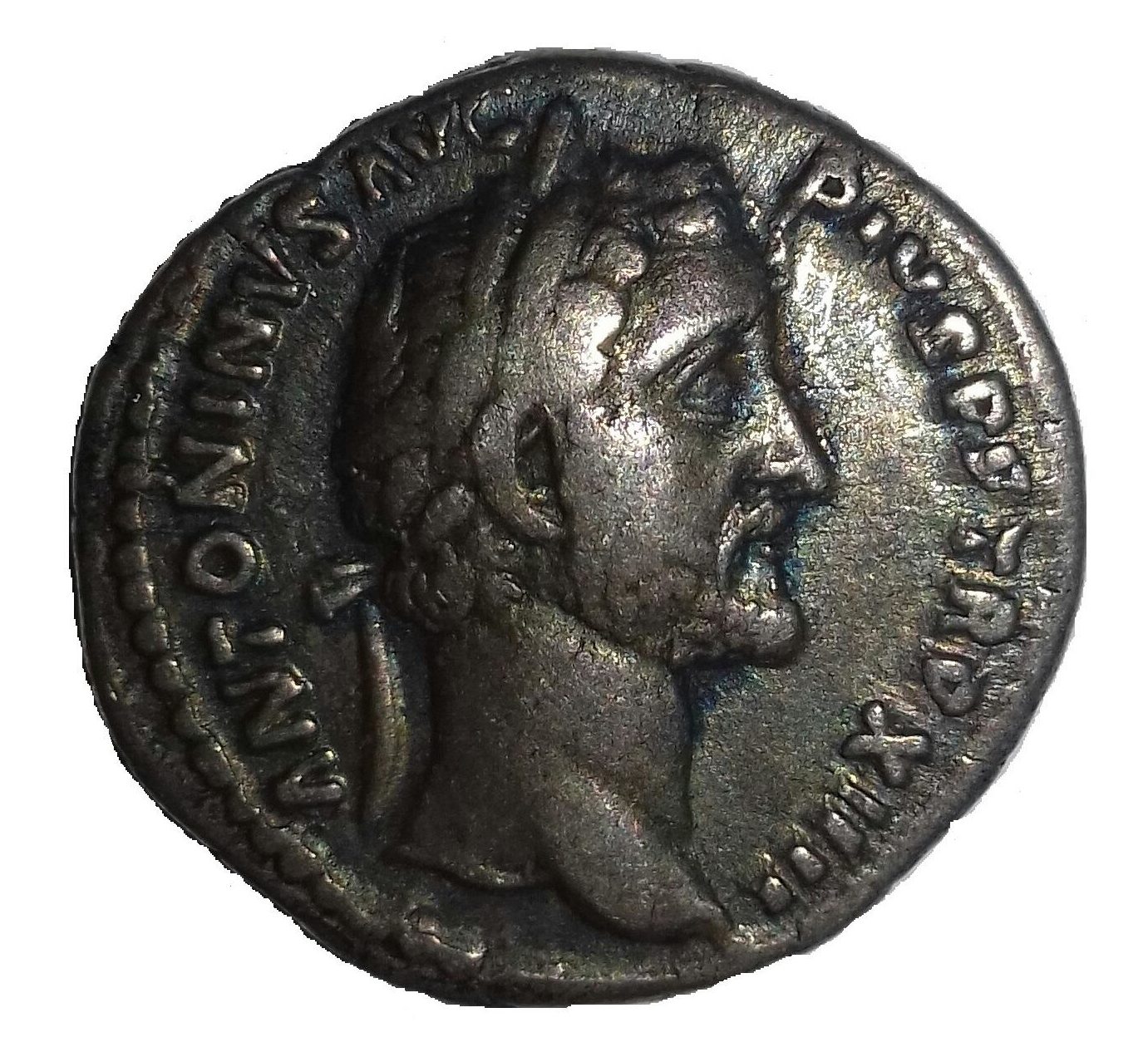
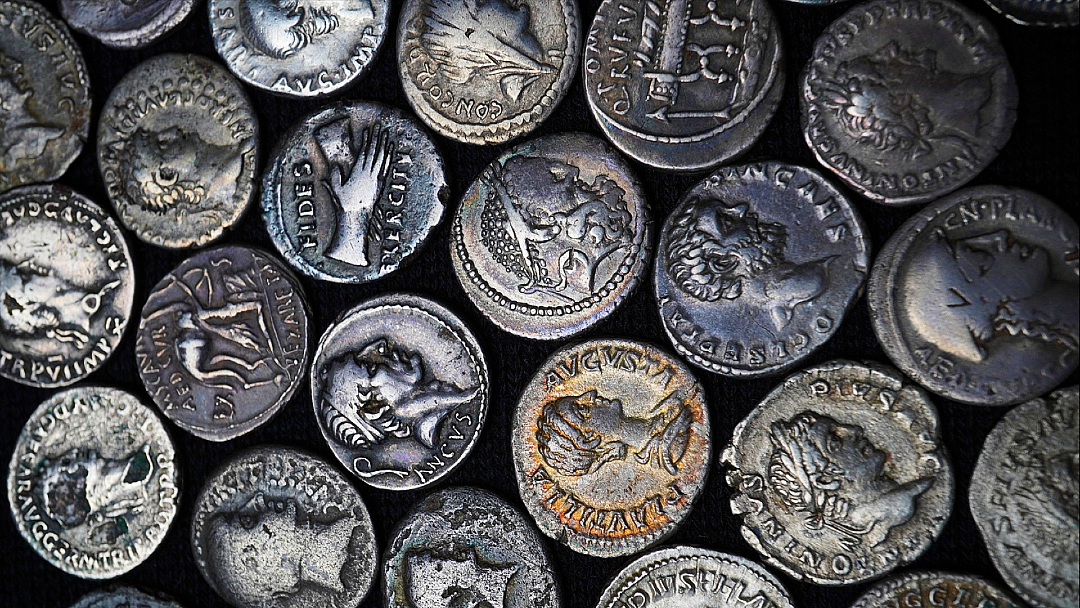
For centuries, the Roman economy revolved around a single coin: the denarius.
Introduced during the Roman Republic, the denarius quickly became the backbone of the Roman monetary system.
Its name comes from the Latin word Denarius, meaning “ten”, because it was originally worth ten asses. Later, its value increased to sixteen asses.
The denarius offered several advantages:
- relatively stable weight;
- high-quality silver;
- strong public confidence;
- circulation throughout the Empire.
It was used for trade, military payments and everyday transactions.
For nearly three centuries, it symbolized the economic stability of Rome.
The Quinarius: The Forgotten Half-Denarius
Far less famous than the denarius, the quinarius was a small silver coin worth half a denarius.
Although it circulated less frequently, it demonstrates the sophistication of the Roman monetary system and its ability to create precise denominations.
The Victoriatus and Foreign Trade
Another important Republican silver coin was the victoriatus. Slightly lighter than a denarius, it was primarily used in regions influenced by Greek culture.
Its purpose was to facilitate trade with territories outside the traditional Roman economic sphere.
Provincial Silver Coinage
The Roman Empire extended far beyond Italy. To meet local economic needs, provincial mints produced their own silver coinage.
Among the best-known examples are:
- the tetradrachm;
- the provincial drachm.
These coins allowed local populations to continue using familiar monetary standards while remaining integrated into the Roman world.
The Arrival of Billon Coinage
During the third century AD, the Empire entered a period of political and military instability. Wars, invasions and civil conflicts placed enormous pressure on imperial finances.
To meet these expenses, Roman authorities gradually reduced the silver content of their coins. This process accelerated with the introduction of the antoninianus under Emperor Caracalla.
Officially valued at two denarii, the antoninianus did not actually contain twice as much silver. Over time, its silver content continued to decline.
What Is Billon?
Billon is an alloy composed mainly of silver and copper.
Initially, silver remained the dominant component. However, successive reductions in silver content eventually transformed many antoniniani into coins that contained little more than a thin silver coating over a copper core.
The consequences were severe:
- inflation;
- declining confidence;
- rising prices;
- economic instability.
Aurelian’s Reform
In response to the crisis, Emperor Aurelian introduced a new coinage known today as the aurelianianus. His goal was to improve quality and restore confidence in Roman money.
Although the reform achieved some success, it was unable to fully reverse the long-term decline.
The Argenteus Under Diocletian
At the end of the third century, Diocletian launched sweeping reforms throughout the Empire.
Among them was the creation of the argenteus, a high-quality silver coin designed to recall the silver coinage of Rome’s golden age.
Today, many collectors consider the argenteus one of the most attractive Roman silver coins.
The Siliqua Under Constantine
A few decades later, Constantine the Great continued the reform process.
Alongside the famous gold solidus, he introduced the siliqua. This silver coin became one of the principal silver denominations of the Late Roman Empire. Its standard weight was approximately 2.24 grams.
Widely struck under emperors such as Constantius II and Julian II, the siliqua eventually experienced reductions in weight, reflecting renewed economic pressures.
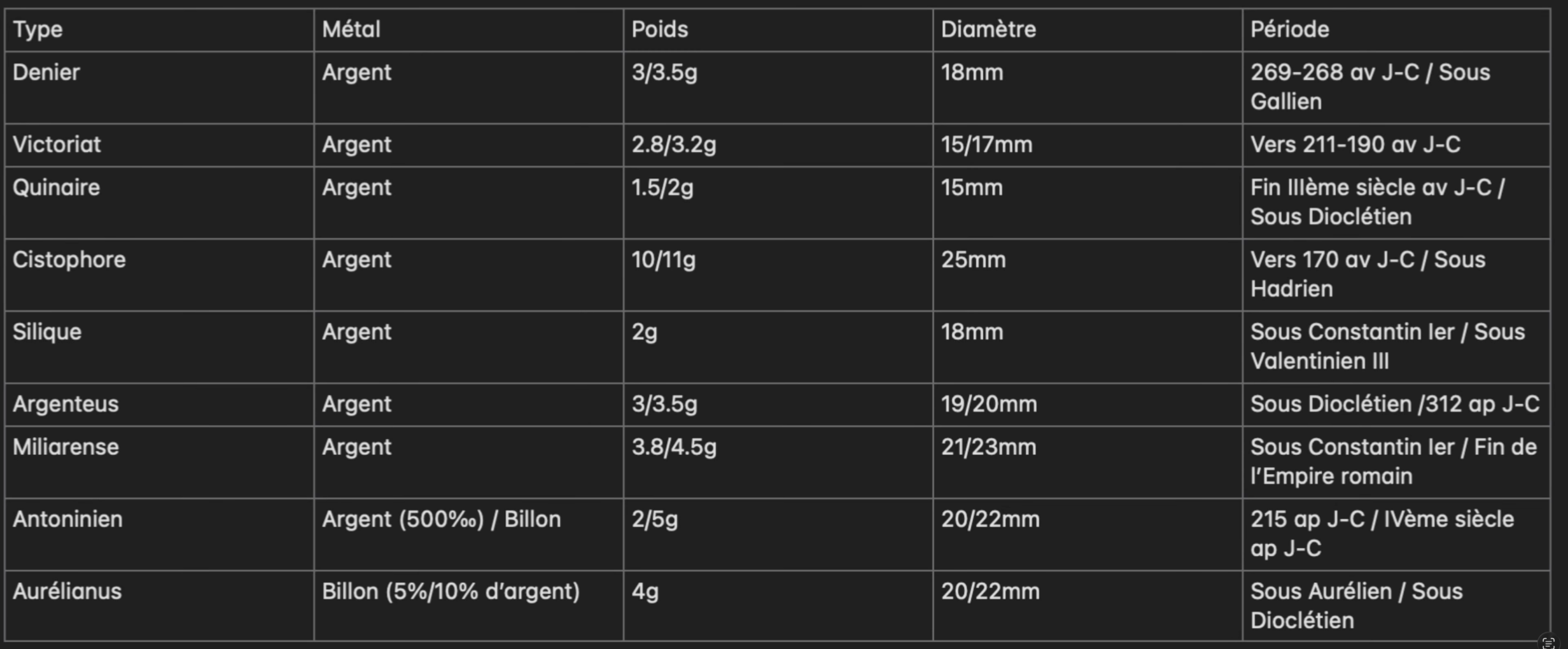
(Here is a table that groups the main types of Roman coins)
Why Are Roman Silver Coins So Popular Today?
Roman silver coins remain among the most sought-after ancient coins.
Collectors appreciate them because:
- they are often well preserved;
- portraits are usually highly detailed;
- they cover centuries of Roman history;
- they directly reflect the rise and decline of the Empire.
Each denarius, argenteus or siliqua represents a tangible connection to the ancient world.
Roman Silver Coins
The history of Roman silver coinage closely mirrors the history of the Roman Empire itself.
The stability of the denarius, the crisis of billon coinage and the later reforms of the argenteus and siliqua all tell the story of Rome’s economic evolution.
For collectors and historians alike, Roman silver coins remain some of the most fascinating witnesses to the ancient world.